
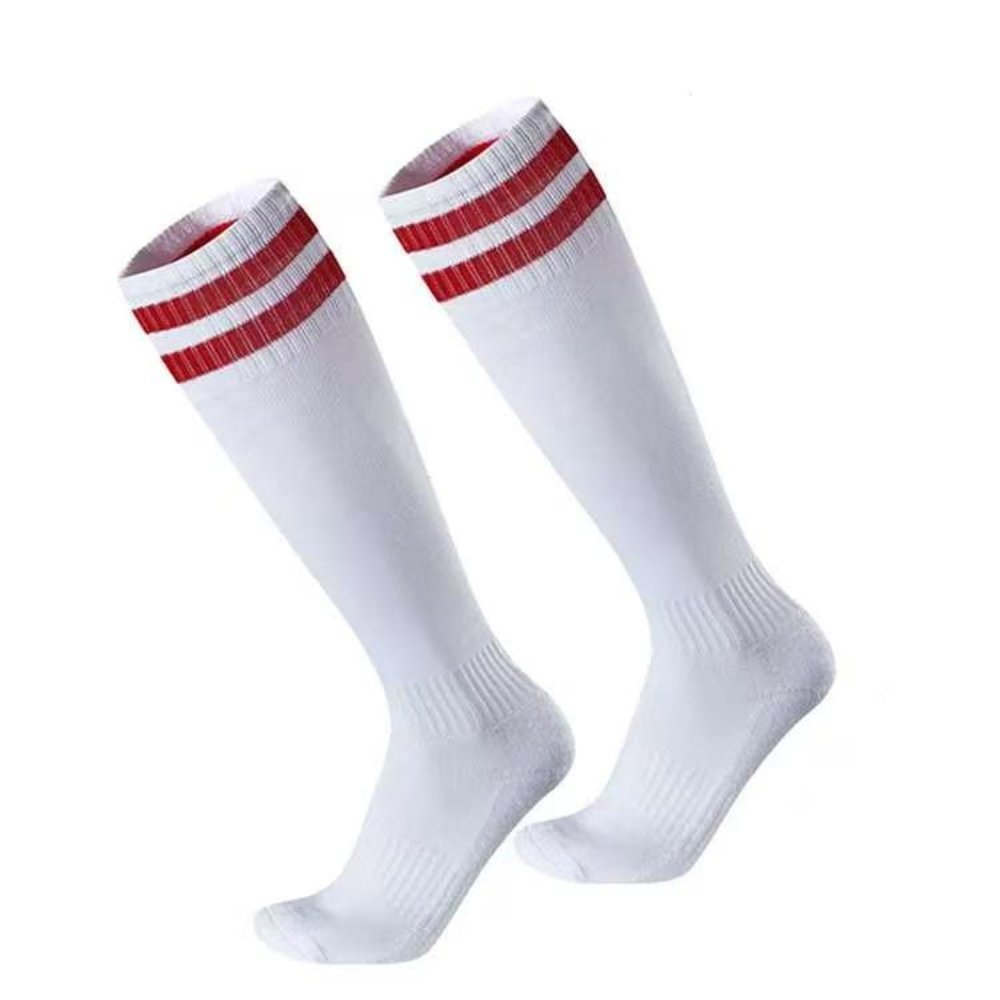
For a football sock RFQ, identify the exact catalogue image before asking the supplier to quote. Link that picture to the supplier item reference and the sample version being discussed. Keep visibly different styles as separate references until the supplier explains their relationship; a shared product page does not establish one interchangeable SKU.
Begin with the listed product and the selected picture
The Professional Over-the-Calf Football Socks – Unisex listing provides a real product reference for an enquiry. Its catalogue imagery includes more than one visible sock appearance. The white socks with red cuff stripes should not silently become the black and neon-green style merely because both appear in the same product context.
When buying wholesale football socks, send the selected image with a short reference label. Preserve the product URL beside it, then ask the supplier which item or offered version the image represents. An image label created for the enquiry helps both parties discuss the same appearance without inventing a manufacturer model number.
Describe visible features as identification details
Useful visible identifiers include the cuff stripe arrangement, the main leg colour and the placement of contrasting areas around the heel or toe. Describe only what is actually visible. These details help locate a reference in a conversation; they do not establish fibre percentages, cushioning construction or an anti-slip test result.
For example, the white and red cuff-stripe reference and the black and neon-green reference have visibly different colour layouts. Retain each as its own enquiry entry. The supplier can then confirm whether it is quoting separate items, presenting alternatives or associating a particular image with a specific available version.
Make an offer-to-picture map
A short map is more useful than a request for the style shown somewhere on the website. Give every proposed version a separate line, even when the buyer plans to select only one. Use the following fields to capture the supplier response without assuming a catalogue photograph is a complete specification.
Reference field | Question for the supplier | Record to retain
Image reference | Which exact picture is being discussed? | Image file or URL with a buyer reference label
Visible identity | What appearance distinguishes this reference? | Cuff, leg, heel and toe observations
Supplier item | Which item does the supplier associate with it? | Supplier item or version reference
Quoted selection | Which pictured version does this quotation cover? | Quotation line and explicit image association
Proposed alternative | Is another appearance being offered instead? | Separate alternative reference and explanation
Sample association | Which sample represents the offered version? | Sample identity and supplier association
Accepted visual version | Which reference has the buyer selected? | Retained approval and subsequent changes
Keep alternatives visible rather than blending them
If the supplier proposes another cuff design or colour layout, add it as an alternative entry. Retain the original request so that the difference remains clear. A visually similar leg shape does not establish that two offers have the same dimensions, material declaration or ordering terms.
Ask the supplier to identify what it is proposing and which reference the revised price concerns. Do not approve an alternative simply by leaving an earlier photograph attached to the conversation. A colleague reading the quotation should be able to identify the selected appearance without reconstructing a long message history.
Associate the sample before reviewing it
When a sample is received, keep its identity with the supplier item and the selected catalogue reference. Record visible differences against that specific reference. This article does not claim that a sample has been received or that any version has passed inspection; it describes a record the buyer can create during an actual sample review.
If the sample differs from the requested image, ask whether it represents a substitution, a revised version or another item. Keep the answer with the sample record. A photograph of a sample can document appearance, while material confirmation, measurements and performance requirements remain separate questions for the offered version.
Separate catalogue identity from performance wording
The product page names Polyester + Spandex as its material and includes performance-oriented prose. Treat the material wording as a catalogue statement for that listing, not proof of the composition of every pictured style. The image map does not verify compression, grip, shock absorption or any health outcome.
If a buyer requires a particular feature, ask the supplier to identify the exact offered version and provide the relevant response or evidence. Keep that requirement separate from the visual selection. A clearly selected cuff pattern answers which appearance is wanted; it does not answer how the sock performs in use.
Retain the selected reference with the quotation
Carry the accepted image association into the quotation record. If the supplier later revises the proposed appearance, retain both the earlier selection and the identified change. Do not allow a general football sock description to replace the exact visual reference the buyer selected.
This approach gives the purchasing team a traceable selection rather than an assumption about the entire gallery. It also leaves price, size availability, order quantities and delivery arrangements open for the supplier to confirm for the particular offer. No commercial commitment is created by the pictured style alone.
• Select one exact image for each enquiry line.
• Use visible features to identify the reference, not to infer performance.
• Keep proposed alternatives and sample identities separate.
• Retain the accepted image-to-offer association with later revisions.
Frequently asked questions
Do all pictures on the same product page represent one SKU?
The shared page does not establish that relationship. Ask the supplier which item each selected image represents before combining references.
Can visible heel or sole patterns prove anti-slip performance?
The image records appearance. It does not independently establish a performance result or the construction of the exact offered item.
What should a buyer do when an alternative style is offered?
Keep it on a separate line with its own image and supplier reference, then record which proposal is selected.
What if the received sample differs from the chosen picture?
Record the difference against the selected reference and ask the supplier to identify the sample version before treating it as the accepted offer.
Send the selected picture references through Yanlei Knitwear contact. Compare actual listings in the product catalogue and explore purchasing topics in the article archive.
Product and contact references
https://ylknitwear.com/product/professional-over-the-calf-football-socks-unisex/
https://ylknitwear.com/contact/
https://ylknitwear.com/products/
https://ylknitwear.com/blog/